Introduction to Solitaire
Solitaire is a card game for one player. Many games use this name, but Klondike is the version most people mean. This guide explains solitaire game how to play with a standard deck.
You need 52 cards, with no Jokers. Your goal is to move every card to four foundation piles, sorted by suit. Players also call solitaire Patience, so searches about patience cards often mean Klondike.
If you want to know how to play solitaire with playing cards, start with the layout and rules below. The same steps explain how to play alone with a deck of cards. You can choose draw-one or draw-three, based on how many cards you turn from the stock.
Klondike is easy to learn, but each deal calls for choices. Some deals cannot be won. Good moves still uncover cards and keep more options open.
Basic Rules of Solitaire
Klondike has four areas: the tableau, stock, waste, and foundations. The tableau has seven columns. The stock holds cards not dealt into those columns, and drawn cards go to the waste.
Build tableau stacks in descending rank and alternate red and black. For example, place a red 8 on a black 9. You may move a valid face-up sequence as one group.
Each foundation holds one suit. Start with an ace, then add cards in order through the king. You win when all 52 cards reach the four foundations.
- Build tableau columns downward, with alternating colors.
- Build foundation piles upward by suit, from ace to king.
- Turn over a face-down card when you uncover it.
- Only a king can start an empty tableau column.
- Only the top card of the waste is ready to play.
These rules cover how do you play basic solitaire. Every legal move must follow the rank and color rules. Check the tableau before drawing from the stock.
Cards in the foundations cannot usually return to the tableau. Some digital versions allow undo, but do not rely on it to learn the rules. Think through each move before you make it.
Setting Up a Solitaire Game
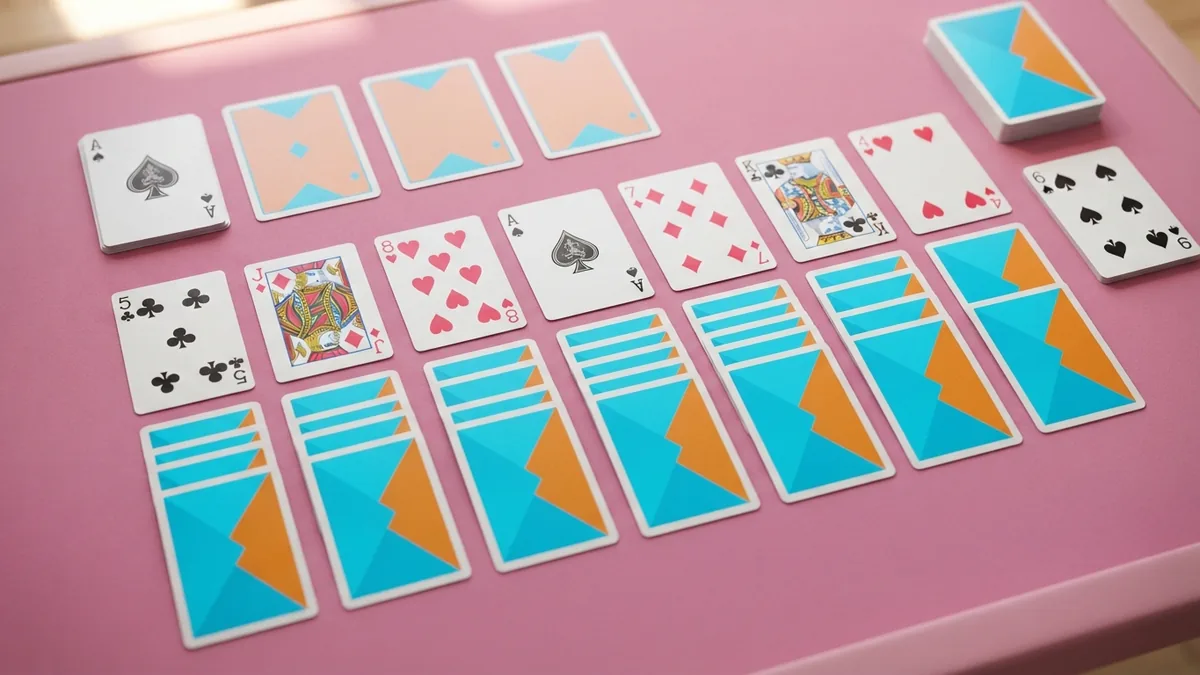
To set up Klondike, shuffle a 52-card deck and deal seven columns from left to right. Deal one card to the first column, two to the second, then add one more card to each next column.
The last column has seven cards. Turn only the top card of each column face up. The tableau uses 28 cards, leaving 24 cards for the stock.
Leave room beside the stock for the waste and four foundations. This setup works when you play solitaire with a pack of cards by yourself. Check that each column has the right count before you begin.
- Column one has one face-up card.
- Column two has one face-down card and one face-up card.
- Column seven has six face-down cards and one face-up card.
Place any available aces on the foundation spaces. Aces may appear in the tableau, so check every face-up card first. The undealt cards form the stock.
There is no special hand or extra pile needed. The word “hand” can mean a set of cards held by a player, but in Klondike, cards stay in the layout. The stock and waste guide your next choices.
How to Play Solitaire
Begin by moving any available ace to a foundation. Then look for tableau moves that reveal face-down cards. For example, move a red 6 onto a black 7 when both are available.
When no useful tableau move is open, draw one card from the stock. Put it face up on the waste. Play it if it fits a tableau column or foundation.
In draw-three, turn over three stock cards at once. Only the top waste card can be played. When the stock runs out, turn the waste over to make a new stock. Some versions limit how often you can recycle it.
- Move available aces to the foundations.
- Make legal tableau moves, with a focus on uncovering cards.
- Play the top waste card when it opens a useful move.
- Draw from the stock when no better move is open.
- Recycle the waste when the stock is empty, if the rules allow it.
This is how to play a solitaire game with common Klondike rules. Check for open moves before drawing. Digital games may offer undo or draw-three settings, so check the rules shown on screen.
Do not rush to move every card to a foundation. A card may help build a tableau stack first. The best move can be the one that reveals a hidden card.
When you uncover a face-down card, turn it face up at once. This adds a new option and may free another card. If you can choose between moves, consider which one reveals the most useful card.

Winning Strategies
Reveal face-down cards as soon as you can. Each new card may open a move or show what a column needs. If two moves are legal, favor the one that uncovers a card, unless it blocks a stronger play.
Use empty columns with care. Only a king can start one, so wait for a king that helps your layout. A useful king may let you move a long sequence or expose several cards.
Do not send every eligible card to a foundation right away. A low card may still help build a tableau stack. For example, a black 4 might need to stay on a red 5 to support another move.
- Check the tableau before drawing from the stock.
- Favor moves that expose face-down cards.
- Save empty columns for kings that improve your layout.
- Track useful cards in the waste, especially when using draw-three.
- Keep lower cards in play when they support a needed stack.
In draw-three, remember which cards sit beneath the top waste card. You may reach them after playing the card above them. A move that seems small can change what you can draw next.
Some deals cannot be won, even with sound play. Still, careful choices improve your odds. Avoid moving cards just because a move is legal; ask what it will reveal or allow next.
When the stock is nearly empty, review the tableau and waste before recycling. A fresh pass may give you another chance to reach a blocked card. Keep track of the order when your version uses a fixed draw-three cycle.
Common Solitaire Variations
Klondike is not the only solitaire game. Spider and FreeCell use different layouts and rules. A move that works in Klondike may not apply to either one.
Spider uses two decks in its common form. Players build descending sequences in the tableau, often aiming to make full runs of one suit. Some versions use one or two suits for an easier game.
FreeCell starts with all cards face up across eight columns. Four open cells can hold single cards for a short time. Planning matters because hidden cards are not part of the challenge.
Pyramid is another popular version, but it has a different aim. Players remove exposed pairs that add up to 13. These variants answer different searches, but they are not the same as Klondike.
| Variation | Main difference | What to expect |
|---|---|---|
| Klondike | Seven tableau columns and a stock | Build four suit piles from ace to king |
| Spider | Usually uses two decks | Build full descending runs in the tableau |
| FreeCell | All cards start face up | Use open cells to shift cards and plan moves |
| Pyramid | Cards form a pyramid | Remove exposed pairs that total 13 |
Choose a version based on the kind of puzzle you enjoy. Klondike adds hidden cards and stock draws. FreeCell rewards planning, while Spider asks you to build long runs.
Conclusion
To learn how to play solitaire, set out seven columns, place the remaining cards in the stock, and build the foundations by suit. On the tableau, stack cards downward in alternating colors. Turn over hidden cards and draw when no useful move remains.
Good play comes from looking ahead. Make moves that reveal cards, save empty columns for helpful kings, and think before sending cards to a foundation. With these rules, you can start a game with a deck or choose a digital version of Klondike.