Understanding the Basics of Solitaire
Classic Solitaire, also called Klondike, is a one-player card game. In some places, people call it patience. To play, you arrange cards into four suit piles, called foundations. Each pile starts with an Ace and builds upward to a King.
The goal is to move all 52 cards to the foundations. You also move cards between seven columns, called the tableau. Tableau runs must descend in rank and switch between red and black. These rules guide most card moves.
You need one standard deck of 52 cards, with no jokers. So, if you wonder how many cards are in Solitaire, the answer is 52. The stock pile holds cards not dealt into the tableau. Cards drawn from it go to the waste, also called the discard pile.
- Tableau: Seven columns where you build descending runs.
- Foundations: Four suit piles, each built from Ace to King.
- Stock: The face-down cards left after the deal.
- Waste: The face-up cards drawn from the stock.
That is the core of how you play Solitaire card game. You uncover hidden cards, make legal moves, and build each suit. A game ends when all cards reach the foundations or no useful moves remain.
Setting Up the Game
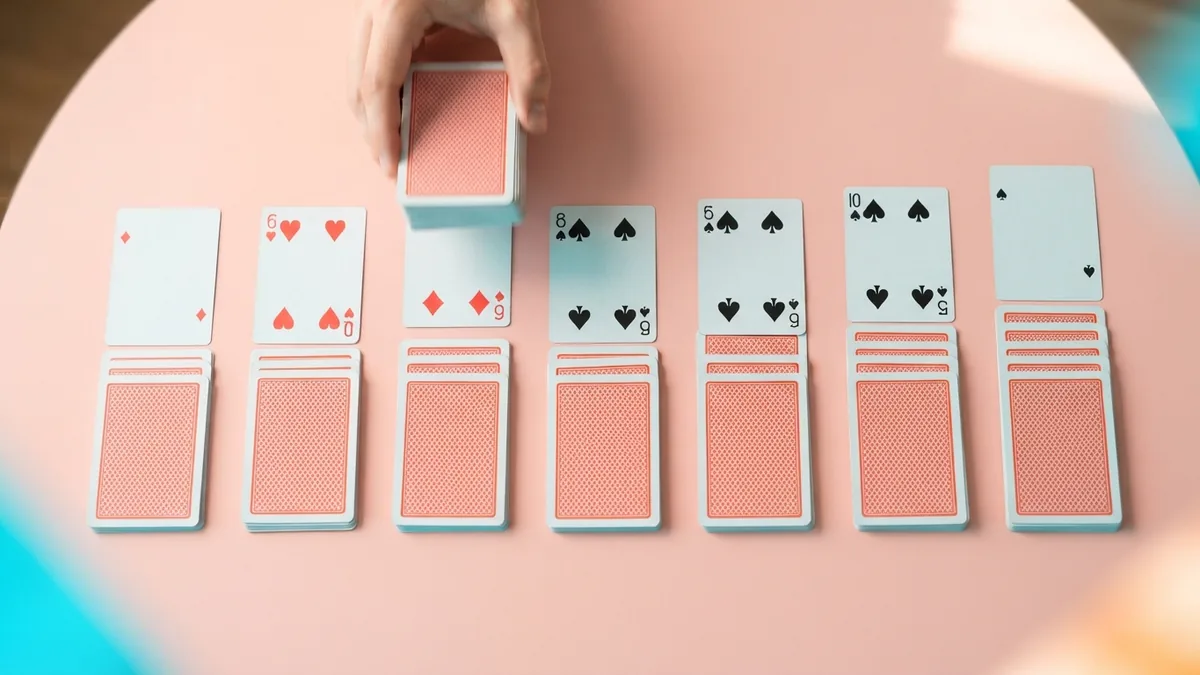
To play Solitaire with real cards, shuffle a standard deck and deal seven columns from left to right. Give the first column one card, the second two, and keep adding one card per column. The tableau uses 28 cards in total.
Turn the top card of each column face up. Keep all other cards in those columns face down. The first column has one face-up card. The last has six face-down cards and one face-up card.
Place the other 24 cards face down beside the tableau. This is the stock pile. Leave room for a waste pile and four foundations. Check that each tableau column has one face-up card at its top before you begin.
This setup is the same whether you want to learn how to play Solitaire card games with real cards or use a digital version. A screen may move cards for you, but the layout and rules stay much the same. Keep the stock within reach.
Rules for Solitaire Gameplay

Move a face-up card onto a card one rank higher and of the opposite color. For example, place a black 6 on a red 7. You can move one card or a valid face-up run. Build each tableau run downward, while switching colors.
When you uncover a face-down card, turn it face up. An empty tableau column can hold only a King. You may move a King by itself or move a face-up run that starts with a King. This rule makes empty columns useful, but only when you can fill them well.
Move each Ace to an empty foundation as soon as it is available. Then add cards of the same suit in order. For example, the 2 of clubs can go only on the Ace of clubs. A card moved to a foundation usually cannot return to the tableau.
When no useful tableau move remains, draw from the stock. In the simple, one-card version, turn one card face up onto the waste. You may play its top card if it fits a tableau run or foundation. When the stock is empty, turn the waste over to make a new stock, based on the rules you chose.
- Move available Aces to the foundations.
- Build descending runs with alternating colors.
- Turn over cards you uncover.
- Draw from the stock when needed.
- Keep building each suit toward its King.
Playing Solitaire Alone
Solitaire is made for one player, so you can play it by yourself with a deck and a clear table. No opponent or special gear is needed. If you ask, “How do you play the card game patience?” the answer is the same: set up the tableau, make legal moves, and build the foundations.
For an easy first game, draw one card at a time. This gives you more chances to use stock cards. Three-card draw reveals three cards at each turn, but only the top waste card is playable. That version is often harder for new players.
Before you start, decide how many times you can recycle the stock. Some players allow unlimited passes, while others set a limit. Digital games often choose this rule for you. With real cards, turn the waste pile over with care so its order stays the same.
Not every deal can be won. A needed card may sit under several face-down cards, or the visible cards may block one another. Still, each game helps you spot moves that open the board. Take your time and check each column before drawing.
Strategies That Improve Your Chances
Try to uncover face-down cards early. A move that reveals a hidden card can give you more choices than shifting cards between visible runs. When two moves are legal, favor the one that opens a column or reveals more of the tableau.
Do not fill an empty column without a plan. Only a King can go there, so check whether you have a useful King or King-led run. Also, avoid moving cards to the foundations too quickly if they may help build a tableau run.
Use the stock with care. Before drawing, look for every legal move in the tableau. If you can choose between a stock card and a tableau move, consider which choice reveals more hidden cards. Small choices can keep the game moving.
Keep suits and colors in mind. A red card may need a black card beneath it to open a path for another move. There is no single winning pattern, but uncovering cards and keeping options open often helps.
Solitaire Variations
There are many Solitaire card games, and the rules change from one version to another. Klondike is the version described here. Its main choices include one-card draw and three-card draw. The layout stays familiar, but stock access changes the challenge.
FreeCell uses a different layout and lets you place cards in open cells for a time. If you wonder how to play the card game FreeCell, note that it has its own move limits and setup. Pyramid is another solo game, where players remove pairs of cards that add to 13.
These games share a solo format, but they are not all played like Klondike. Learn the rules for the version you choose before dealing. For a first game, stick with one-card Klondike and add harder variants once its moves feel clear.
FAQs About Solitaire
How do you play Solitaire the card game?
Deal seven columns, then build descending runs with alternating colors. Move Aces to the foundations and add cards by suit, from Ace to King. Draw from the stock when you need more cards.
How many cards are used in Solitaire?
Classic Klondike uses one standard deck of 52 cards. It does not use jokers.
Can you play Solitaire by yourself with real cards?
Yes. You need one deck and a flat space for the tableau, stock, waste, and foundations. The game is designed for one player.
How do you play three-card Solitaire?
Use the usual Klondike setup, but turn three stock cards face up per draw. Only the top card in the waste pile is playable. Rules for stock passes can vary, so agree on them before play.
Can any card go in an empty tableau column?
No. Only a King can fill an empty column. A face-up run that begins with a King can also move there.