Understanding Sudoku Basics
A standard Sudoku has a 9-by-9 grid split into nine smaller 3-by-3 regions. Each row, column, and region must contain the numbers 1 through 9 once. No number can repeat in any of those areas.
Those rules hold for easy grids and tough ones alike. The difficulty changes how many clues you get and how much deduction you need. The core logic stays the same.
If you wonder, “How do I solve a Sudoku puzzle?” start by checking the three areas around an empty cell. Numbers already in its row, column, or region cannot go there. The numbers left are its candidates.
Each entry should follow from a rule or a clear deduction. Avoid guessing at the start. A sound placement often reveals another move nearby.
- Row: A horizontal line with nine cells.
- Column: A vertical line with nine cells.
- Region: A 3-by-3 block within the grid.
Understanding these parts gives you a way to solve Sudoku problems without relying on luck. It also helps you spot errors early. Check the row, column, and region each time you enter a number.
Common Sudoku Techniques
Begin with scanning. Choose a number, such as 7, and check each row, column, and region for places where it can fit. If only one cell in a region allows 7, place it there.
Cross-hatching is a focused form of scanning. Look at the rows and columns that already contain a chosen number. Their paths rule out cells in a region. If one cell remains, the number belongs there.
Next, check for a naked single. That is an empty cell with only one candidate. Remove numbers found in its row, column, and region. If only one number remains, enter it.
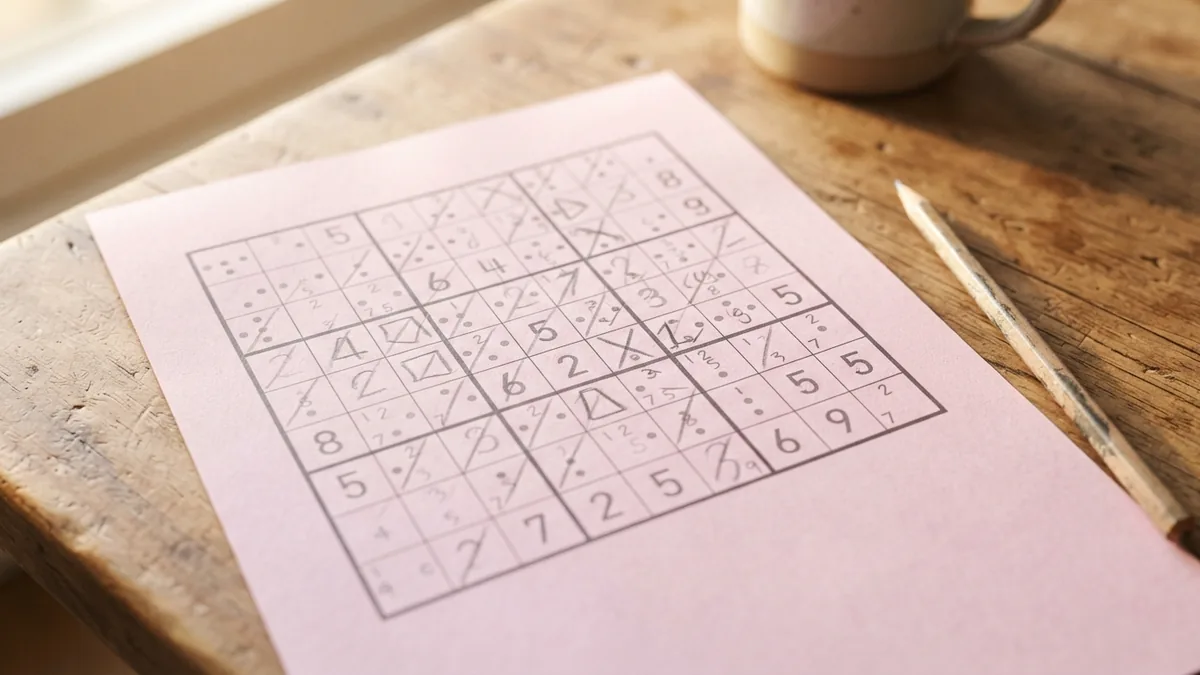
Pencil marks help when a cell has several candidates. Write the possible numbers lightly in the cell, then update them after each new entry. Old or wrong notes can hide a move.
- Scan one number across the whole grid.
- Use cross-hatching to rule out cells.
- Find cells with only one candidate.
- Keep pencil marks current and tidy.
A naked pair can also narrow a search. If two cells in one area share the same two candidates, those numbers belong in those cells. Remove both candidates from other cells in that area.
These basic solving strategies answer many questions about how to solve Sudoku. Find a forced move, enter it, and scan again. Small steps add up.
How to Solve Sudoku Puzzles Step by Step
A steady routine helps you solve Sudoku puzzles step by step. Start with simple checks, then try patterns if no clear move appears. After each entry, review its row, column, and region.
- Scan the grid. Start with rows, columns, or regions that have few empty cells.
- List missing numbers. Choose one area and note the numbers it still needs.
- Check open cells. Rule out numbers already in each cell’s row, column, or region.
- Place forced numbers. Enter a value only when one candidate or one spot remains.
- Add pencil marks. Note the candidates when no direct move appears.
- Look for patterns. Check for singles, pairs, or candidates limited to one line.
- Review the grid. Confirm each row, column, and region has 1 through 9 once.
For example, a region may be missing 2, 6, and 9. Two empty cells may sit in columns that already contain 2. Neither cell can hold 2, so the third cell must hold it.
If you get stuck, do not enter a random number. Check your notes, then scan a new number or area. A missed candidate may explain the block.
This is a reliable way to solve any Sudoku puzzle without rushing into guesses. Repeat the checks until the grid is full. Then confirm that all three rules still hold.
Tips for Difficult and Advanced Sudoku
A difficult Sudoku may need more than singles and pairs. Look for a number that can fit in only one row within a region. It must go somewhere in that row. Remove that candidate from other cells in the row.
The reverse pattern works too. If every possible spot for a number in one row lies within one region, remove that number from other cells in that region. These moves are called pointing and claiming.
For a tricky grid, track where each candidate can go. If two cells in a row, column, or region share a pair, that pair may rule out candidates elsewhere. Keep your notes exact.
Use advanced Sudoku techniques only after basic scans stop producing moves. A wrong note can make a sound pattern seem impossible. Recheck the candidates before acting.
Some players test a value when a puzzle gets tough. Mark it as a trial, then follow its results carefully. If it creates a clash, undo the trial and check your earlier deductions.
For extreme puzzles, work in small steps. Recheck the affected areas after each move. Patience beats a string of guesses.
- Check whether a candidate is limited to one row or column.
- Look for pairs before using harder patterns.
- Review notes when a puzzle seems stuck.
- Use a trial only when you can track and undo it.
Sudoku is a logic puzzle, so solving it mathematically means using the grid’s rules to rule out choices. It does not require advanced math. Clear notes and careful checks do the work.
Practice and Improve Your Solving Speed
Practice with puzzles at a level where you can spot some moves without help. Easy grids build a feel for scanning and singles. As those checks become quick, move to harder puzzles and add one new pattern at a time.
Use a printed puzzle or a trusted online Sudoku game. A paper grid makes pencil marks easy to review. Online play can help you track time and reset mistakes, but avoid hints until you have checked your own notes.
To build speed, focus on clean habits rather than rushing. Scan the same way each time, and pause after each placement to check nearby cells. Fewer errors often save more time than fast guesses.
When a puzzle is finished, review where you slowed down. Note whether scanning, candidate marks, or a pattern caused the delay. Practice that skill on the next grid.
There is no single trick that solves every puzzle. A repeatable process helps with easy grids and challenging ones. Keep using the rules, and let each deduction guide the next.