What Is Minesweeper?
Minesweeper is a single-player puzzle game played on a grid of covered squares. Your goal is to reveal every safe square without opening a mine. One wrong move can end the round, so each clue matters.
To learn how to play Minesweeper, focus on three actions: reveal, count, and reason. A safe square may show a number or a blank. Numbers count nearby mines, including those on diagonal squares.
If you have wondered, “How do I play Minesweeper?” start with a small board. You do not need quick hands or special gear. Careful counting is the main skill.
The rules stay much the same across game versions. Board size, mine count, and controls can vary. Some games also offer a safe first move, while others may not.
Set Up the Game and Learn the Controls
Choose a board and difficulty before you begin. Beginner boards often use a 9-by-9 grid with 10 mines. Other versions may use different sizes or let you set your own board.
On a computer, left-click a covered square to reveal it. Right-click often places a flag where you think a mine sits. Check the game’s help screen, since controls can differ.
On mobile, tap to reveal a square. A long press often places a flag, but some apps use a separate flag button. Try the controls on a new board before playing for a fast time.
Searches such as “how to play Minesweeper on Google” or “how to play Minesweeper on Google mobile” may lead to different versions. The same number clues still apply. Look for the game’s controls, then start with its easiest board.
- Pick a small board while learning.
- Check how the game marks a suspected mine.
- Use flags as notes, not as proof.
Controls can change, but the puzzle logic does not.
What Do the Numbers Mean in Minesweeper?
Each number tells you how many mines touch that square. There are up to eight neighbors: above, below, beside, and diagonal. A 1 means one of those nearby squares contains a mine.
Suppose a 1 touches just one covered square. That covered square must be a mine. If a 2 touches two covered squares, both must hold mines.
Now use the clues to find safe squares. If a 1 already touches one flagged mine, its other covered neighbors are safe. The number’s mine count is met.
A blank square has no mines beside it. Many games open nearby safe squares automatically after you reveal a blank. This can expose a large part of the board.
- A 1 needs one mine among its covered neighbors.
- A 2 needs two mines among its covered neighbors.
- Count diagonal squares as well as side squares.
- Recheck your flags if a number seems impossible.
These simple counts answer the common question, “What do the numbers mean in Minesweeper?” Each number is a local clue. It does not describe the whole board.

Basic Minesweeper Strategy for Safer Moves
For a first move, try a corner or an edge. These squares have fewer neighbors than squares in the middle. That can make the first clues easier to read.
After each reveal, check every nearby number. Count its covered neighbors and compare that count with the number shown. Mark a mine only when the clues prove its location.
Next, look for covered squares beside numbers whose mine count is already met. Those squares are safe to open. This is the core of a sound Minesweeper strategy.
For example, a 1 touches one flagged mine and two other covered squares. Both other squares are safe, since the 1 needs only one mine. Open them and use any new clues.
- Reveal a corner or edge square to get clues.
- Count all covered neighbors around each number.
- Flag a square only when the clues support it.
- Open covered neighbors once a number’s mine count is met.
This method explains how to play the Minesweeper game without relying on luck at every turn. It also helps you avoid false flags. Keep checking clues after each reveal.
Advanced Tips: Flags, Patterns, and Risk
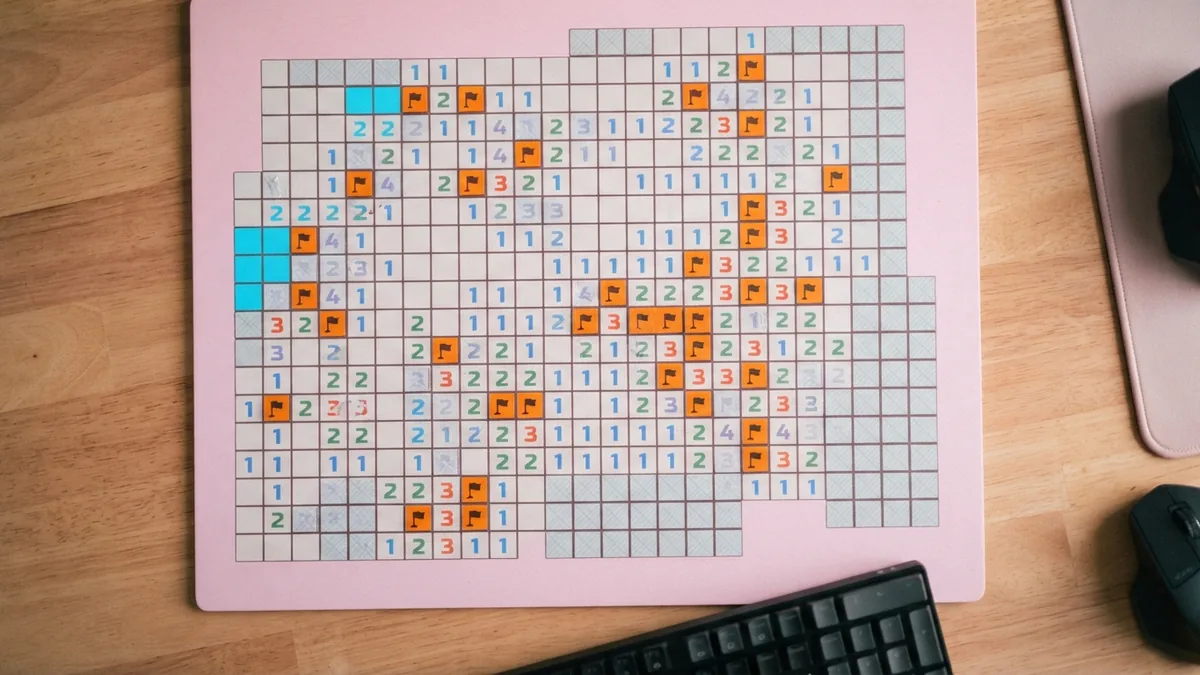
Flags help you track possible mines, but a flag does not make a square safe. Treat each flag as a note. Check it against nearby numbers whenever new squares open.
Compare clues that share covered neighbors. A 1 and a 2 may touch the same two covered squares. If the 2 has one extra covered neighbor, that extra square may be a mine.
Use that pattern only after checking every neighbor. Other nearby numbers may change the answer. A pattern is useful when the full set of clues supports it.
Some boards leave no move that logic can prove safe. Then compare possible layouts. If one square holds a mine in one of four equally likely layouts, its risk is about 25 percent.
Choose the square with the lower mine risk when you must guess. Do not treat an estimate as certainty. A good player knows when the board has stopped offering a sure answer.
Common Mistakes to Avoid
Random clicking can end a game before you use its clues. Pause after each reveal and scan all nearby numbers. One square may help explain several clues at once.
Flagging too soon can cause a chain of bad counts. A guessed flag may make a number look solved when it is not. Remove a flag if new clues no longer support it.
Players also miss diagonal neighbors or count only the newest clue. Check all eight directions around each number. If a count seems wrong, review nearby squares and flags before moving.
Do not assume every game gives a safe opening move. A corner can be a useful start, but it is not a guarantee. Read the rules for your version.
Practice, Speed, and Playing on Different Devices
Practice improves both speed and accuracy. Start with a small board and aim for correct counts, not quick finishes. Familiar patterns will become easier to spot over time.
After a loss, review the move that caused it. Ask whether a number gave you a safe option. If not, ask whether another square had a lower risk.
A Minesweeper speedrun is a timed effort to finish as fast as possible. Learn the controls and basic patterns before chasing a record. Fast play helps only when your counts stay sound.
On a phone or other mobile device, use the game’s stated tap and flag controls. Give yourself time to select the right square. If taps feel cramped, zoom or choose a larger board.
Queries like “how to play Minesweeper on mobile” often reflect a control question. The key rules remain the same on a small screen. Tap to reveal, mark mines as the game allows, and read each clue.
How to Beat Minesweeper
To beat Minesweeper, reveal every safe square while keeping clear track of likely mines. Start with easy clues, use proven counts, and save guesses for boards with no sure move.
Keep your focus on what the numbers show. Do not rush a reveal just to improve your time. A careful round teaches more than a quick loss.
Once you know the controls and can count nearby squares, try a larger board. Build speed through practice, not random clicks. The best next move is the one the clues support.