Understanding Sudoku Basics
Sudoku is a logic-based number puzzle played on a nine-by-nine grid. Your goal is to fill every empty cell with a digit from 1 to 9. Each digit must fit the rules of its row, column, and three-by-three box.
The printed digits are clues. Keep them in place, then use them to work out which digits can go in nearby cells. You do not need to add or multiply. The digits act as symbols, and the puzzle depends on careful number placement.
If you are asking, “How do I do Sudoku?”, start by checking what an empty cell cannot hold. A digit already in its row, column, or box is ruled out. The remaining digits are that cell’s candidates.
- Rows run from left to right.
- Columns run from top to bottom.
- Each box covers three rows and three columns.
This is not a race. A careful scan often beats a quick guess.
Rules of Sudoku
Every row must contain the digits 1 through 9 without repeats. The same rule applies to every column and every three-by-three box. A digit can appear many times across the full grid, but only once in each group.
Before placing a digit, check all three groups that touch the cell. Look at its row, then its column, and then its box. If that digit appears in any of them, the cell cannot hold it.
For example, a row might already contain 1, 2, 4, 6, and 9. The cell’s column may contain 3 and 8. That leaves 5 and 7 as options, unless the box rules one out.
A digit that fits two groups but fails the third is not a valid move. Wait until the clues make one choice certain. This check is the heart of the Sudoku puzzle and how to play it fairly.
Step-by-Step Guide to Solving Sudoku
Begin with groups that have only one or two empty cells. A group with one gap gives you an immediate answer. Then look for a digit that has only one possible place in a row, column, or box.
- Scan nearly full groups. Check rows, columns, and boxes with few empty cells.
- Find missing digits. Note which numbers each group still needs.
- Rule out blocked cells. Check each empty cell against its row, column, and box.
- Place a sure digit. Enter a number only when one cell can hold it in that group.
- Update nearby notes. Remove the new digit from notes in its row, column, and box.
- Scan again. A sure entry may reveal another simple move.
This is how to fill Sudoku cells without guessing. Suppose a box lacks 2, 5, and 8. In one empty cell, the row rules out 2, while the column rules out 5. That cell must hold 8.
Candidate notes can help when a cell has several options. Write small digits in the cell, such as 3, 6, and 8. Erase an option when a new entry rules it out. Keep notes neat and current.
Move between rows, columns, and boxes instead of staring at one area. You can also track one digit across all nine boxes. This back-and-forth often reveals a placement you missed.
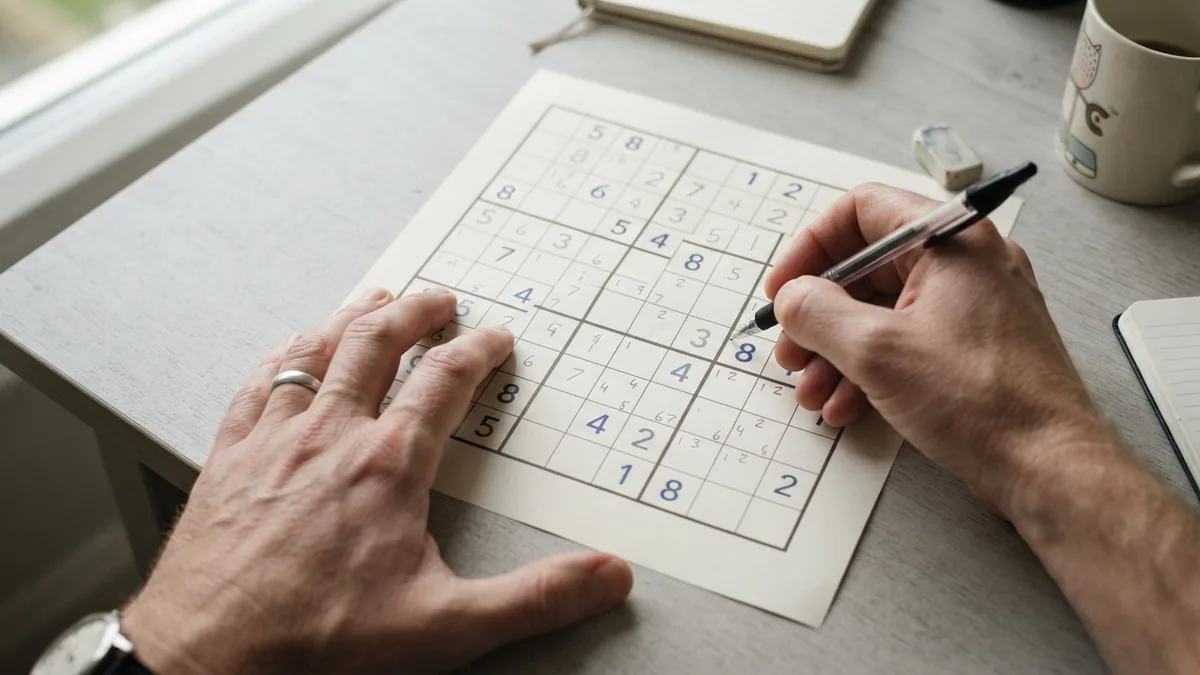
Tips for Beginners
If you want to learn how to do Sudoku for beginners, start with easy puzzles. They often offer many direct placements, so you can practice a steady scan-and-check routine. Try to explain every entry with a clear clue.
Use two kinds of scans. First, check each row and column for missing digits. Next, pick one digit and see where it can fit in nearby boxes. These methods reveal different kinds of sure moves.
Use notes only when they help. You do not need to list every option in every empty cell. Start with cells that have few choices, then add notes if the grid stops offering easy moves.
Keep a simple loop: find a sure move, enter it, update nearby notes, and scan again. If you feel stuck, inspect the grid from another direction. A missed single may stand out after a short break.
- Check nearly full groups before open areas.
- Scan one digit across several boxes.
- Do not enter a number without a reason.
- Try harder puzzles when easy ones feel clear.
Speed comes with practice. Clear reasoning matters more than finishing quickly.
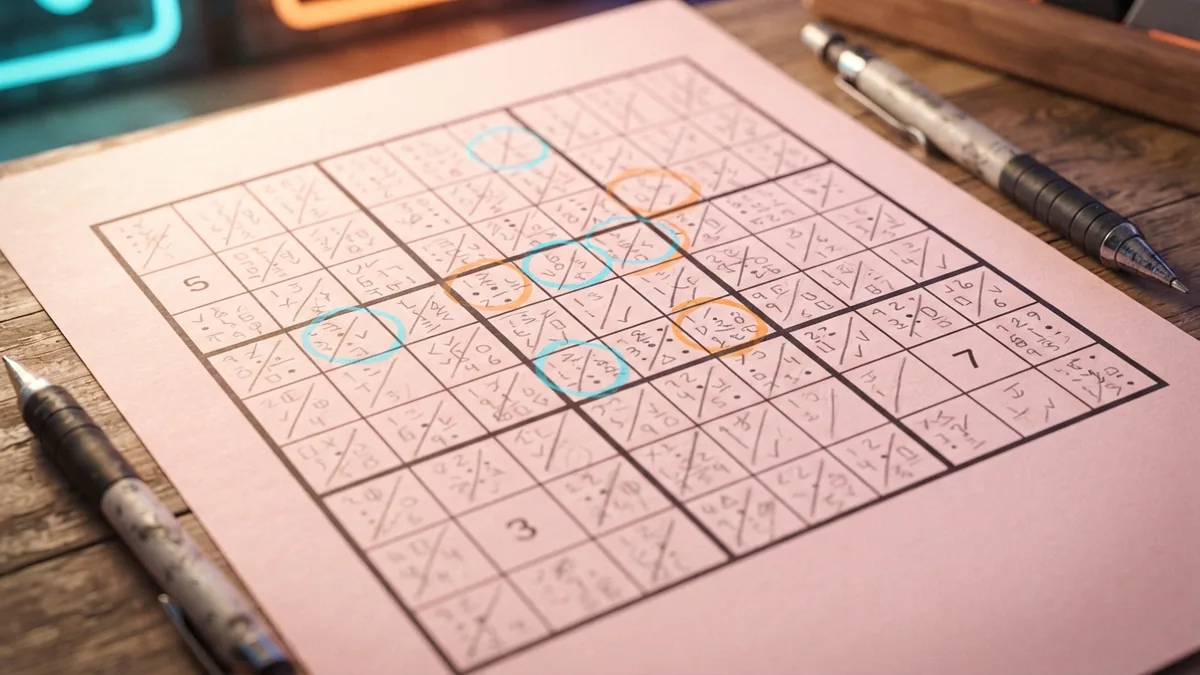
Strategies for Difficult Puzzles
Harder puzzles may not offer an obvious single at first. Add candidate notes to empty cells, then compare the options within each row, column, and box. Look for patterns that rule out digits from several cells.
A pair is one useful pattern. If two cells in a group can hold only the same two digits, those digits belong in those cells. You may not know their order yet. Still, remove both digits from other cells in that group.
Another pattern appears when a digit can fit in only one row within a box. That digit must go somewhere in that row. Remove it from other cells in the same row, outside the box.
For very hard grids, compare candidate sets across groups. If three cells share only the same three candidates, those digits are reserved for those cells. Use this only when your notes are accurate. A wrong note can lead to a false deduction.
Do not jump to a guess just because a puzzle feels tough. Review each candidate and look for a rule that removes it. These steps are useful when learning how to do difficult Sudoku, but basic scans still matter most.
Common Mistakes to Avoid
A common mistake is overlooking a simple placement. Players may search for complex patterns while a nearly full row already has one missing digit. Scan the easy groups again before trying a harder method.
Another mistake is placing a number because it seems likely. A cell with two candidates is still uncertain. Wait for a new clue to remove one option, or leave both in your notes.
Stale notes can also cause trouble. After every sure entry, update the notes in the same row, column, and box. If the grid seems to contradict itself, check recent entries and notes first.
When a puzzle stalls, pause and restart your scan. Check missing digits by group, then track one digit across the grid. This routine helps you spot missed clues without undoing sound work.